
티스토리 뷰
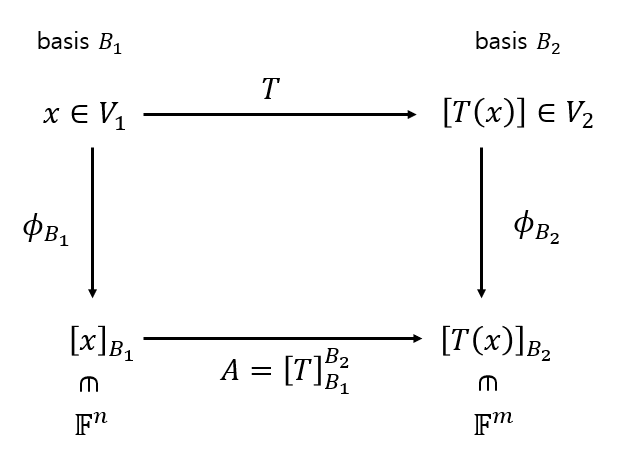
Let $V_1$, $V_2$ be vector spaces, $\text{dim}(V_1)=n$, $\text{dim}(V_2)=m$. Also let
\begin{align}
B_1 = \{ \beta_1, \cdots, \beta_n \} \\
B_2 = \{ \gamma_1, \cdots, \gamma_m \}
\end{align}
be bases of $V_1$ and $V_2$, respectively. Every vector $x \in V_1$ is uniquely expressed as
$$x = b_1 \beta_1 + \cdots + b_n \beta_n$$
For a linear transformation $T: V_1 \to V_2$, the image of each basis vector of $V_1$ is uniquely expressed as
$$T(\beta_k) = \alpha_{1k}\gamma_1 + \cdots + \alpha_{mk}\gamma_m$$
Because $T$ is linear,
\begin{align}
T(x) &= b_1 T(\beta_1) + \cdots + b_n T(\beta_n) \\
&= b_1 (\alpha_{11} \gamma_1 + \cdots + \alpha_{m1}\gamma_m) \\
\vdots \\
&+ b_k (\alpha_{1k} \gamma_1 + \cdots + \alpha_{mk}\gamma_m) \\
\vdots \\
&+ b_n (\alpha_{1n} \gamma_1 + \cdots + \alpha_{mn}\gamma_m)
\end{align}
Rearranging,
\begin{align}
T(x)
&= (\alpha_{11}b_1 + \cdots + \alpha_{1n}b_n)\gamma_1 \\
\vdots \\
&+ (\alpha_{k1}b_1 + \cdots + \alpha_{kn}b_n)\gamma_k \\
\vdots \\
&+ (\alpha_{m1}b_1 + \cdots + \alpha_{mn}b_n)\gamma_m \\
\end{align}
The coefficient of $\gamma_k$ is
\begin{align}
\begin{pmatrix}
\alpha_{k1} & \cdots & \alpha_{kn}
\end{pmatrix}
\begin{pmatrix}
b_1 \\
\vdots \\
b_n
\end{pmatrix}
\end{align}
or, as a matrix form,
\begin{align}
\begin{pmatrix}
\alpha_{11} & \alpha_{12} & \cdots & \alpha_{1n} \\
\alpha_{21} & \alpha_{22} & \cdots & \alpha_{2n} \\
\vdots & \vdots & \ddots & \vdots \\
\alpha_{m1} & \alpha_{m2} & \cdots & \alpha_{mn} \\
\end{pmatrix}
\begin{pmatrix}
b_1 \\
\vdots \\
b_2 \\
\vdots \\
b_n
\end{pmatrix}
\end{align}
is the coordinate of $T(x)$ in $B_2$, denoted by $[T(x)]_{B_2}$.
If we denote $A:=(\alpha_{ij})$, in fact $A$ is
\begin{align}
A = \begin{pmatrix}
| & | & & | \\
[T(\beta_1)] & [T(\beta_2)] & \cdots & [T(\beta_n)] \\
| & | & & |
\end{pmatrix}
\end{align}
which is complete natural, because
\begin{align}
\begin{pmatrix}
b_1 \\
\vdots \\
b_n
\end{pmatrix}
\end{align}
is the coordinate of $x$ in $B_1$, denoted by $[x]_{B_1}$.
We call $A$ the matrix representation of a linear transformation from $V_1$ to $V_2$, denote by $[T]_{B_1}^{B_2}$.

In the figure above, $T = \phi_{B_2}^{-1} A \phi_{B_1}$.
Using sigma notation,
\begin{align}
x = \sum_{j=1}^{n} b_j \beta_j
\end{align}
\begin{align}
T(\beta_k) = \sum_{i=1}^{m} \alpha_{ik} \gamma_i
\end{align}
\begin{align}
T(x)
&= \sum_{j=1}^{n} b_j T(\beta_j) \\
&= \sum_{j=1}^{n} b_j \sum_{i=1}^{m} \alpha_{ij} \gamma_i \\
&= \sum_{j=1}^{n} \sum_{i=1}^{m} \alpha_{ij} b_j \gamma_i \\
&= \sum_{i=1}^{n} \gamma_i \sum_{j=1}^{m} \alpha_{ij} b_j
\end{align}
'mathe' 카테고리의 다른 글
| Rank-Nullity Theorem과 그 이면의 구조에 대하여 (0) | 2025.08.15 |
|---|---|
| If AB = E, then BA = E. (0) | 2025.08.11 |
| 필요조건과 충분조건, statement와 expression (0) | 2025.06.30 |
| Basic properties of group homomorphism (0) | 2025.01.22 |
| [HORIZON] 전구의 불은 켜질까? (0) | 2025.01.13 |